Approved Supplier on the G-Cloud Services Framework

Meta Cannect Ltd. has successfully been awarded a place in the Cloud Software
category within the G-Cloud 9 framework for the First Response range of services.

James Candy, founder of Meta Cannect said ‘This is a real milestone for our young
innovative business and will help us to reach more of our valued public sector
customers, giving them the confidence that Meta Cannect has met the criteria set out
in the G-Cloud 9 framework. The G-Cloud 9 framework provides a cost effective and
fast route for procurement of cloud services, we are proud to be part of this and look
forward to serving more public sector customers.’

First Response allows the emergency services to use the emergency caller’s smartphone to locate using GPS, stream live video and message with auto translation of up to 50 languages.

The G-Cloud framework was originally launched in 2012 and has already met many
of its original aims, making the procurement process for cloud services easier and
faster for all parts of UK government. The latest iteration G-Cloud 9 is now live and
available via the UK government’s Digital Marketplace.

Approved Supplier on the G-Cloud Services Framework

First Response – Updates

Our First Response platform is constantly being improved with new and updated features. This post will show some of the exciting updates and features that have recently been added.

Overview map

mapVideos_smaller

We have added a live overview map that shows all current callers locations, as well as the mobile response units (tracking optional for mobile response units). Clicking on a call opens a popup that displays the live video stream (if available) and a button that allows the call handler to open the call into the main window. If the caller is moving the markers will also move on this overview map.

Video playback

PausePlayback

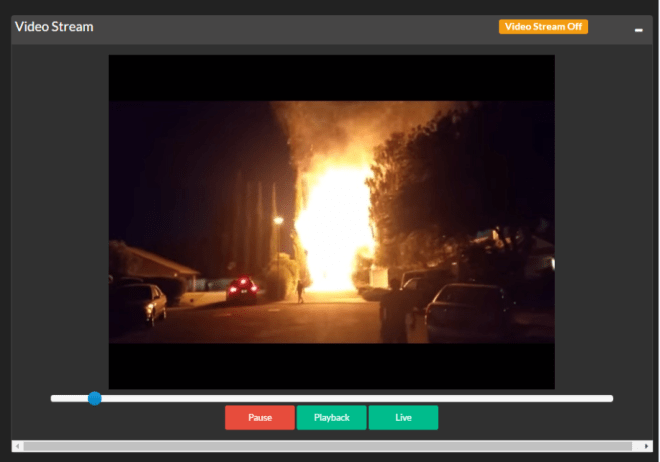
Our live stream feature now supports live pause and playback. The user can now pause a live stream and rewind the video using the time bar slider to replay the video in real time. The time is also displayed so the user can go to a specific time if required. The user can switch back to the live stream at any time.

Re-configurable feature panels

playbackAndNewPanels

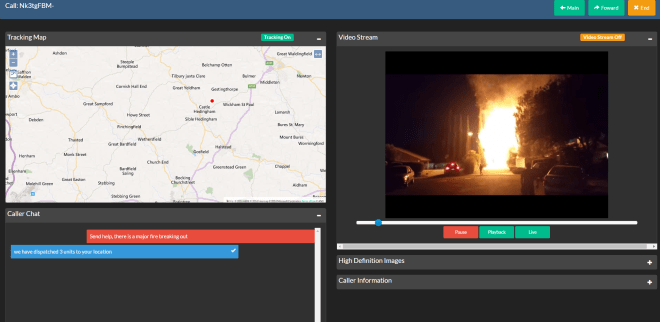
Each feature panel can now be minimized/expanded and dragged to different parts of the screen. This enables the user to tailor the call details window to their own preference.

Other changes

We have :

  • simplified the user interface whilst simultaneously expanding  the on screen space available to the user. This gives an easier to use and richer user experience.
  •  added a table of all available mobile response units if they are currently on a call.
  • changed  the Mobile Response application so that it is now a web application rather than a native app. This change enables us to provided better support and makes deploying the application much easier for users.

Meta Cannect Ltd has an extensive road map of new features that we will be adding over the coming months. For more information or to request a new feature please contact us on 07850 949023 or john.mulcahy@meta-cannect.com.


First Response – Updates

Contacting the Emergency Services – calling for change in a digital age.

Today the use of Smart phones is common place with over 66% of the population owning or using one.  According to the latest Ofcom report ‘The UK is now a “Smart phone” society’ (Ofcom:The Communications Market Report 2015: United Kingdom.) The vast majority (90%) of 16-24 year olds own one; but 55-64 year olds are also joining the smartphone revolution, with ownership in this age group more than doubling since 2012, from 19% to 50%.

ofcom_phone_users

http://stakeholders.ofcom.org.uk/market-data-research/market-data/communications-market-reports/cmr15/

The Emergency Services now take over 70% of their calls from Smart phones and yet despite some recent developments contact is still just a phone call and verbal description of the unfolding scene.


Growing calls for the take up of technology


In June 2015 The Institution for Engineering and Technology produced a report ‘Contacting Emergency Services in the Digital Age’ which claims that as a society we are ‘digital by default and data rather than voice dominate’….’Most calls are made from mobiles – and the modern Smart phone has extensive capabilities (such as call trace, messaging, video, GPS enhanced mapping) that can greatly improve response but which are currently not being fully used.’  The report goes on to call for standards to be set up and entrepreneurs to take up the challenge to develop software and services to take advantage of this ubiquitous technology.

http://www.theiet.org/factfiles/comms/999-digital-page.cfm


In December 2015 Ofcom released it’s ‘Connected Nations Report’ where it suggests that more could be done to improve the Emergency Services and that ‘new technology brings new and potentially life-saving capabilities’.

‘The communications capabilities of mobile phones have expanded hugely over recent years, adding text messaging, pictures, video and high speed data transfer to basic voice. Smartphones have developed many other features which can be useful in the context of emergency communications, including accurate knowledge of current location, sensors and apps able to monitor user health, environmental sensing, high-resolution cameras and large screens.

The wealth of data these capabilities make available is potentially very useful in dealing effectively with emergencies. There is an opportunity to integrate this data into the way the emergency services operate, minimising delay and errors, and at the same time greatly increasing the available information about any given situation.’

The report goes on to say ‘For the vast majority of users, interaction with the 999 service is still entirely voice based. This is contrast with general telecoms use, which has seen voice traffic in steady decline on fixed networks and showing minimal growth on mobile, at a time when broadband data traffic on both platforms has been growing hugely. There is a risk that for many users, and particularly younger users for whom these trends are strongest, the communications methods they turn to first will not allow them to access the emergency services.’

http://stakeholders.ofcom.org.uk/binaries/research/infrastructure/2015/downloads/resilient_comms.pdf


Introducing First Response – using your Smart phone for more than just voice


First Response is a professional service which aims to provide emergency operators in 999 Emergency Operator Centres with three aspects to improve response times and outcomes.

Firstly an accurate location using the caller’s smart phone’s GPS, secondly video or high resolution images of the scene using the phone’s camera and if language is a barrier, they can use the ‘Chat’ feature which auto-translates the 15 most popular languages in the UK.  The Responder on the way to the incident can also benefit from the video and chat features, with the Call Operator relaying critical information and video footage from the caller including any changes in location through the tracking feature.

The service operates on all mobile phones and networks, using an SMS (text message) to provide a link to a web ‘App’ from where the caller can enable tracking, video and chat features.  This cross platform / network functionality means that Emergency Operations Centres can utilise all smart phones regardless of their manufacturer or service provider.

We believe that First Response will help to address the technology gap and take advantage of a ‘ready now’ service that can either run as a stand-alone web service or integrated into an existing workflow and CAD system.

For further information please visit our web site and blog or alternatively contact John Mulcahy. john.mulcahy@meta-cannect.com

http://www.meta-annect.com/#sec4

https://metacannectdotcom.wordpress.com/2016/03/02/the-first-response-ecosystem/

Contacting the Emergency Services – calling for change in a digital age.

The First Response Ecosystem

First Response is a platform that enables responders to gain vital information about a caller’s situation. It is designed around modern web protocols, using the latest technology. It has a very simple to use interface for both the caller and the call handler, allowing training to be done in minutes.

When used in combination the First Response platform is a powerful tool that will save lives and help the emergency services shave vital minutes off the response times.

The ecosystem currently has 4 main components:

OverViewDiagram

Server/Database Cloud:

The backend server and audit database run in the cloud and are accessible 24/7. The traffic to and from is fully secured using SSL and HTTPS authentication, and the audit database is password encrypted. The server is highly optimised to allow maximum throughput and ensure all calls are handled efficiently. The auditing database keeps track of every transaction made during a call, so a full suite of customised reporting can be carried out, from the smallest detail to the bigger picture

Caller Web Application:

mobile_entry

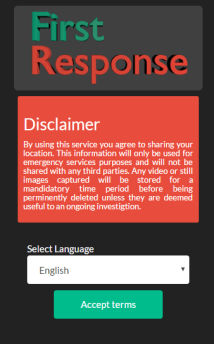
This is the component that the caller interacts with. It is a highly optimised web application, designed to work on even the slowest mobile network. It has a very simple to use user interface and changes dynamically dependent on the user’s phone capabilities. It allows the caller to transmit their location, stream video, upload high definition imagery and text chat in up to 45 different languages with our live chat translation feature.


Call Centre Client:

Call centre call

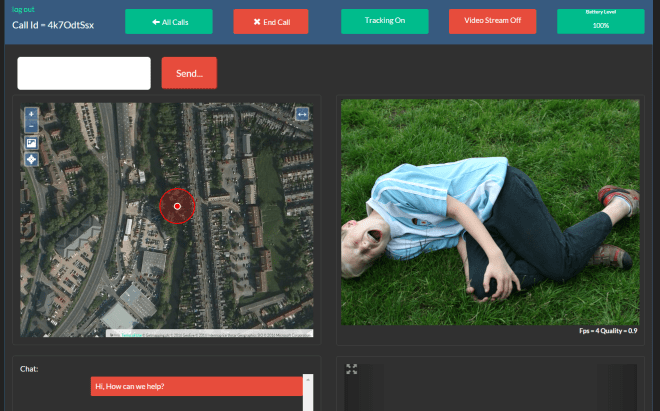
This component is used by the call centre operator. It is very easy to use, and is completely web based so there is no need for any custom software installations or changes to hardware infrastructure. Calls can be managed from start to finish using this component or it can be integrated into existing CAD work flows. The operator can use this interface to see the caller on the map, see the live video that is being streamed and see the high definition images that have been sent. They can also use the live translation chat feature from this screen allowing them to converse with someone in a different language. The operator can also see a screen shot of the user’s device so that they know what the user can see on the screen at any one time. They can also forward calls to the mobile response application so that the responders can see the same information whilst on route.

Mobile Response Web Application:

MobileResponse

This is a web app that can be used on an in-vehicle device or on a handheld device by a responder. It allows the call centre to forward a call to the device so that the responder can see the same information as the call centre, such as the location, video stream and high definition imagery that is coming from a caller. It also shows the responders location on the map relative to the callers to assist in locating the caller on the ground.


The First Response Ecosystem

Introducing First Response

Introducing First Response, the first web based service to use a smart phone’s GPS to accurately and quickly locate an emergency caller.   The response time for many emergencies is critical often leading to life saving situations, the Ambulance services’ 8 minutes target is the pinnacle of these.   For most incidents an arrival time of less than 60 minutes is called the golden hour where more crimes are solved, lives are saved and property less damaged.

First Response is a professional service which aims to provide emergency operators in 999 emergency call centres with an accurate location using the caller’s smart phone.  The GPS in smart phones is activated using an SMS message to point the browser towards the First Response web application.  When activated the GPS location is immediately broadcast, pin pointing their location on a detailed background map. The caller can then use other functions including streaming live video or take a high resolution picture of the incident.  If the caller’s primary language is not the same as the call centre operator, they can use the ‘Live Translate Chat’ feature which auto-translates the 25 most popular languages in the UK including  Urdu, Hindi, Welsh, Polish and other European languages.
Early data from live testing looks to reduce the time to locate a caller to less than one minute.  Not only will this enable more emergency services to hit their response time targets but will save lives as well.

We are actively engaging with the emergency services to pilot First Response to allow us to collect more data and improve the service.  Please contact us on 07850 949023 or john.mulcahy@meta-cannect.com.

Introducing First Response