Today the use of Smart phones is common place with over 66% of the population owning or using one. According to the latest Ofcom report ‘The UK is now a “Smart phone” society’ (Ofcom:The Communications Market Report 2015: United Kingdom.) The vast majority (90%) of 16-24 year olds own one; but 55-64 year olds are also joining the smartphone revolution, with ownership in this age group more than doubling since 2012, from 19% to 50%.

http://stakeholders.ofcom.org.uk/market-data-research/market-data/communications-market-reports/cmr15/
The Emergency Services now take over 70% of their calls from Smart phones and yet despite some recent developments contact is still just a phone call and verbal description of the unfolding scene.
Growing calls for the take up of technology
In June 2015 The Institution for Engineering and Technology produced a report ‘Contacting Emergency Services in the Digital Age’ which claims that as a society we are ‘digital by default and data rather than voice dominate’….’Most calls are made from mobiles – and the modern Smart phone has extensive capabilities (such as call trace, messaging, video, GPS enhanced mapping) that can greatly improve response but which are currently not being fully used.’ The report goes on to call for standards to be set up and entrepreneurs to take up the challenge to develop software and services to take advantage of this ubiquitous technology.
http://www.theiet.org/factfiles/comms/999-digital-page.cfm
In December 2015 Ofcom released it’s ‘Connected Nations Report’ where it suggests that more could be done to improve the Emergency Services and that ‘new technology brings new and potentially life-saving capabilities’.
‘The communications capabilities of mobile phones have expanded hugely over recent years, adding text messaging, pictures, video and high speed data transfer to basic voice. Smartphones have developed many other features which can be useful in the context of emergency communications, including accurate knowledge of current location, sensors and apps able to monitor user health, environmental sensing, high-resolution cameras and large screens.
The wealth of data these capabilities make available is potentially very useful in dealing effectively with emergencies. There is an opportunity to integrate this data into the way the emergency services operate, minimising delay and errors, and at the same time greatly increasing the available information about any given situation.’
The report goes on to say ‘For the vast majority of users, interaction with the 999 service is still entirely voice based. This is contrast with general telecoms use, which has seen voice traffic in steady decline on fixed networks and showing minimal growth on mobile, at a time when broadband data traffic on both platforms has been growing hugely. There is a risk that for many users, and particularly younger users for whom these trends are strongest, the communications methods they turn to first will not allow them to access the emergency services.’
http://stakeholders.ofcom.org.uk/binaries/research/infrastructure/2015/downloads/resilient_comms.pdf
Introducing First Response – using your Smart phone for more than just voice
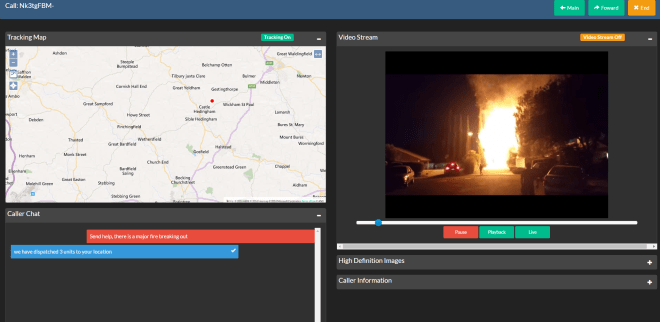
First Response is a professional service which aims to provide emergency operators in 999 Emergency Operator Centres with three aspects to improve response times and outcomes.
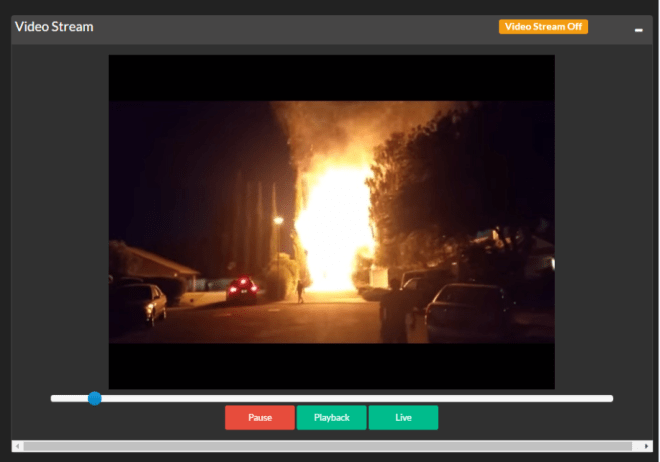
Firstly an accurate location using the caller’s smart phone’s GPS, secondly video or high resolution images of the scene using the phone’s camera and if language is a barrier, they can use the ‘Chat’ feature which auto-translates the 15 most popular languages in the UK. The Responder on the way to the incident can also benefit from the video and chat features, with the Call Operator relaying critical information and video footage from the caller including any changes in location through the tracking feature.
The service operates on all mobile phones and networks, using an SMS (text message) to provide a link to a web ‘App’ from where the caller can enable tracking, video and chat features. This cross platform / network functionality means that Emergency Operations Centres can utilise all smart phones regardless of their manufacturer or service provider.
We believe that First Response will help to address the technology gap and take advantage of a ‘ready now’ service that can either run as a stand-alone web service or integrated into an existing workflow and CAD system.
For further information please visit our web site and blog or alternatively contact John Mulcahy. john.mulcahy@meta-cannect.com
http://www.meta-annect.com/#sec4
https://metacannectdotcom.wordpress.com/2016/03/02/the-first-response-ecosystem/


 Meta-Cannect Blog